Neitje Friesen
Women TalkingNeitje Friesen, sixteen, is the daughter of the late Mina Friesen and the permanent ward of her aunt Salome Friesen. Her father, Balthasar, was sent by Peters to the remote southwest of the country to buy twelve yearlings and has not returned. This history leaves Neitje positioned between absence and responsibility: she is young, but already part of the adult women’s gathering where the future of their families and colony is being decided. She contributes not only as a participant but as an image-maker, messenger, and advocate for the younger generation.
Identity and Circumstances
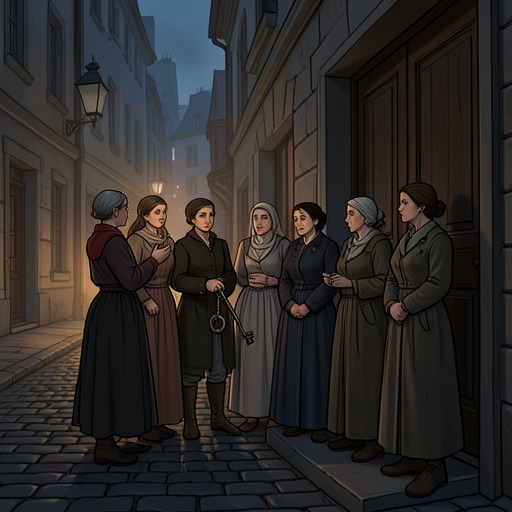
Neitje belongs to the Friesen family, whose women have gathered with the Loewens to consider their response to the attacks in Molotschna Colony. The assembled women represent three generations, and the account identifies them as repeat victims. Their meeting takes place amid a wider crisis: from 2005 to 2009, more than three hundred girls and women were rendered unconscious and attacked in their beds, with an attack occurring on average every three or four days. Neitje’s presence therefore belongs to a community-wide deliberation, not a private family discussion.
Her circumstances also distinguish her within that community. Her mother is dead, her father has remained away for years, and Salome has become her permanent guardian. The household and kinship structures around her are consequential as the women weigh leaving: their choices concern not only their own safety but the care of children and the future of the colony. The evidence does not give Neitje a separate account of her own plans, but repeatedly places her among those expected to help carry out the women’s collective decision.
Work in the Women’s Deliberations
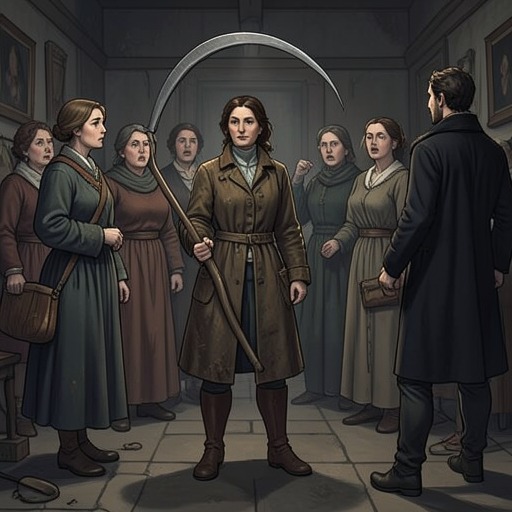
Because the women do not read, each of the three possible responses is accompanied by an illustration. Neitje creates the images. For Do Nothing, she draws an empty horizon; for Stay and Fight, she draws two colony members in a knife duel. The other women consider that second image too violent, although its meaning is unmistakable. Neitje’s work makes abstract political alternatives legible to a group that cannot rely on written ballots or printed explanations. The empty horizon also holds an ambiguity: it is assigned to doing nothing, yet the narrator privately recognizes that it could represent leaving as well. The images do not settle the choice; they give the women a way to see and discuss it.
Neitje and Autje are also appointed to carry the discussion beyond the loft. As the youngest and speediest women in the Friesen and Loewen families, they agree to give oral reports at the end of the day, when everyone has returned to her house. Their role is practical as well as representational: some women do not attend the meetings, either because they have chosen the Do Nothing option or because they are too young to understand the proceedings. Meanwhile, the colony’s essential chores must continue, particularly milking and feeding the animals. Neitje’s reports help connect the deliberating group with women whose labor keeps the community functioning.
Friendship, Kinship, and Participation
Neitje’s closeness to Autje is conveyed through a small, deliberate gesture. During discussion of the advantages and disadvantages of leaving, the two remove their kerchiefs and braid their long hair together into one braid. The image makes their companionship visible: they are separate people, but in that moment physically joined. Their friendship also has a public dimension, since they share the responsibility of reporting back to other women and are both treated as younger participants whose questions matter.
When Agata suggests that Autje and Neitje be allowed to leave the meeting to help with the evening chores, Salome objects. The younger women, she points out, have asked pertinent questions about boys and men; they should remain for the discussion and hear the answers. Salome’s intervention is protective without reducing Neitje to a child whose place is elsewhere. It insists that those affected by the decisions, including the young women, are entitled to hear the reasoning behind them. Neitje’s attendance thus becomes part of the meeting’s intergenerational work: the group is considering a future that she and Autje will have to inhabit.
Age, Safety, and the Future
That future includes a difficult question about boys aged thirteen and fourteen. Fifteen-year-old boys are already with the men, while boys twelve and under may leave with the women; the intermediate ages risk being left in the men’s care. Salome asks why they cannot accompany the women and whether the accused attackers, if released on bail, might target them. Mejal supports the question. The narrator’s answer recognizes that boys of this age can cause harm, but also describes them as children capable of learning with direction, firm love, and patience. The distinction matters to Neitje’s place in the debate: the women must consider safety without treating every young person as beyond change.
The proposed departure is not presented as a simple escape from danger. It would reshape family ties and responsibilities, and Neitje’s own history makes the stakes of guardianship especially tangible. Salome is her aunt and permanent guardian; the two young women’s reporting work links scattered households to the women’s deliberations; and their questions concern who will be protected and taught if the group leaves. The decisions about boys and men therefore bear directly on the kind of community the women hope to build, rather than only on where they will live.
Attention to the Young and the Unchosen
Neitje’s manner can be unhurried even when others are waiting. When Salome urges her to go, she does not immediately move. She rises languidly from her pail, stretches in silence, and fixes her hair until Salome, exasperated, calls her name sharply. The moment adds a modest counterpoint to the urgency of the gathering: Neitje is not only a symbol of youth or a useful courier, but a person whose pace can frustrate the adults around her.
Near the preparations for departure, Neitje and Autje react with distress when they learn that Cornelius will not be joining the women. His mother has chosen the Do Nothing camp, and he has no choice but to remain with her. The young people of Molotschna, especially the girls, are fond of Cornelius for his jokes, comedy, and creativity. Agata suggests that he and his mother might yet change their minds and join the women elsewhere, but Mariche insists that this will not be possible once the men return. Neitje’s response registers a loss within the larger collective decision: the departure may protect those who go, but it cannot bring every valued person with them.
Across these scenes, Neitje’s significance lies in the concrete ways she helps the women think and communicate. Her pictures translate choices into visible forms; her and Autje’s reports extend the meeting beyond its walls; and Salome’s insistence that she stay affirms the younger women’s right to participate in consequential discussions. Her braided hair with Autje and her distress over Cornelius also show that the deliberation is bound up with friendship and attachment, not merely with a choice among abstract options. Neitje stands at once within the colony’s vulnerable younger generation and among the people helping imagine what might come after it.